

This post was written by my dear friend Pat (@ptotime). Thanks, Pat!

Green Arrow, by Ray Lago; and Huntress, by Hector Gomez.
During the pandemic, there was a hot moment where all of the stuff that Wizard Magazine lied about being worth something someday actually WAS worth something. This was purely a function of the market: while working from home, bored Xennials spent more time on eBay, looking up things that they used to enjoy. Suddenly, there was demand to meet the Internet’s inexhaustible supply of 1980s and 1990s pop culture ephemera. Old toys, old video games, old comic books — everyone who, at age 8, was certain that their Web of Spider-Man #100 (First Appearance of the Spider-Armor; green holo-foil cover) was going to be worth money lived out the monkey’s paw fulfillment of that wish when online sellers convinced them that the dose of nostalgia was worth $35 or whatever. (After all, it’s a Key Issue.)
One area affected by this nostalgia boom was non-sports trading cards. Some lines remain over-supplied and under-demanded no matter what. You can buy a sealed box of DC Bloodlines trading cards for less than it retailed in 1992. This is because the Bloodlines cards were vastly overproduced during the strong part of the early 90s speculator boom, and also because even today, no one likes Bloodlines. On the flipside, by 1995-1996, the bubble had well and truly burst, and trading cards were being produced in quantities that suggested cut-to-the-bone manufacturing profit margins. The ’95 and ’96 Marvel Masterpieces would have cost you a lung or a liver for even a loose base set, even pre-pandemic.
Somewhere in between is the 1994 DC Master Series.

The Thing by Darick Robertson, from the 1994 Marvel Universe set; the Invisible Woman by the Hildebrandt Brothers, from the 1994 Marvel Masterpieces; Galactus by Jack Kirby (and a load of unappealing digital effects), from the 1994 Marvel Flair Inaugural Edition; Spider-Man vs. Venom by Mark Bagley, from the 1994 Amazing Spider-Man set; and Cable vs. Wolverine by Dan Brereton, from the 1994 X-Men Ultra set.
Produced by SkyBox in the year before it was eaten up by Fleer, the 1994 DC Master Series was intended as a catch-all response to Marvel’s various trading cards lines. In 1994 alone, Marvel had the Marvel Universe series, which focused on documenting the previous year’s worth of continuity; the art-focused Marvel Masterpieces series, which in 1994 were entirely painted by Greg and Tim Hildebrandt; and the Marvel Flair Inaugural Edition, which were sold at double the asking price of a regular pack of cards, were printed on double-thick cardstock that ruined most trading card binder pages, and featured of-the-moment computer re-coloring of classic images in a way that looks hideously heavy-handed now. Spider-Man and the X-Men also received franchise-focused sets, with Spider-Man’s set entirely drawn by seminal Spider-artist Mark Bagley, and the X-Men getting a foil-stamped, fully-painted “Fleer Ultra” line.
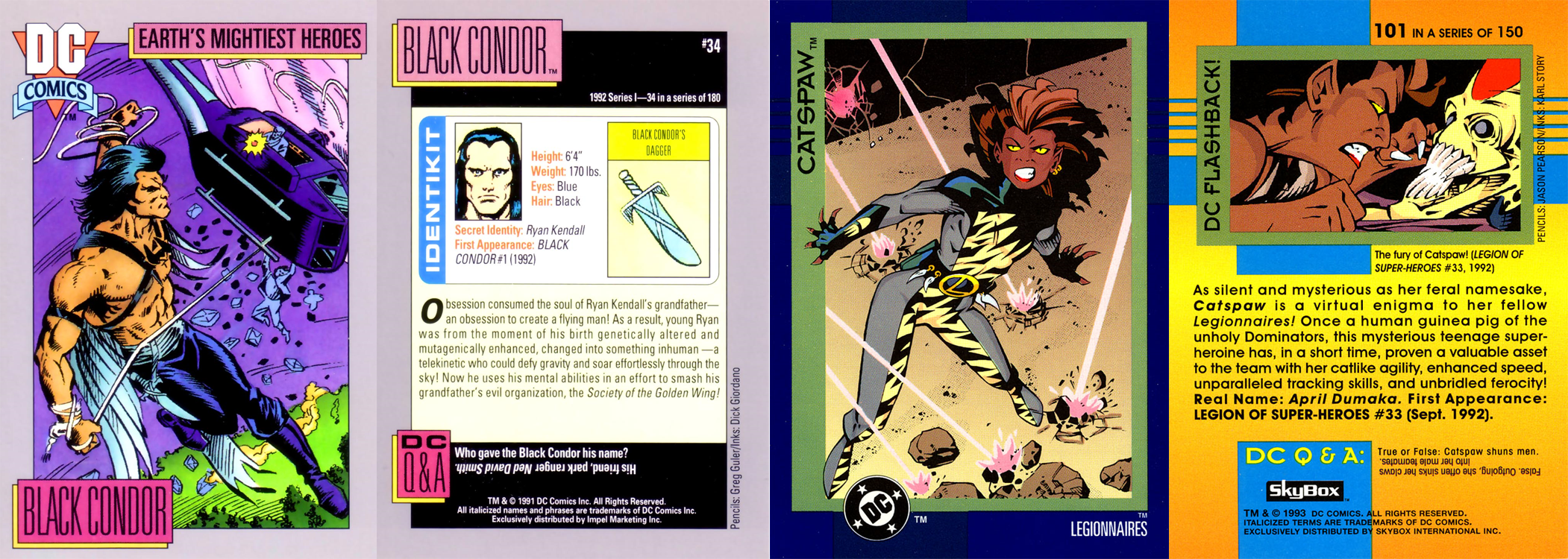
Black Condor by Greg Guler, from the 1991 DC Cosmic Cards set; and Catspaw by Jason Pearson, from the 1993 DC Cosmic Teams set.
DC’s previous trading card lines with SkyBox had focused on history, continuity, and information. From 1990-1992, DC produced issues of “Who’s Who in the DC Universe” that were packaged as looseleaf sheets pre-punctured for three-ring binders. 1991’s Cosmic Cards essentially picked up that role and continued on with it, and 1993’s Cosmic Teams did the same, though with a bit more graphical flair. Neither series included any characters from the Batman universe, as the rights to Batman and all his subsidiary characters were at the time held by Topps.
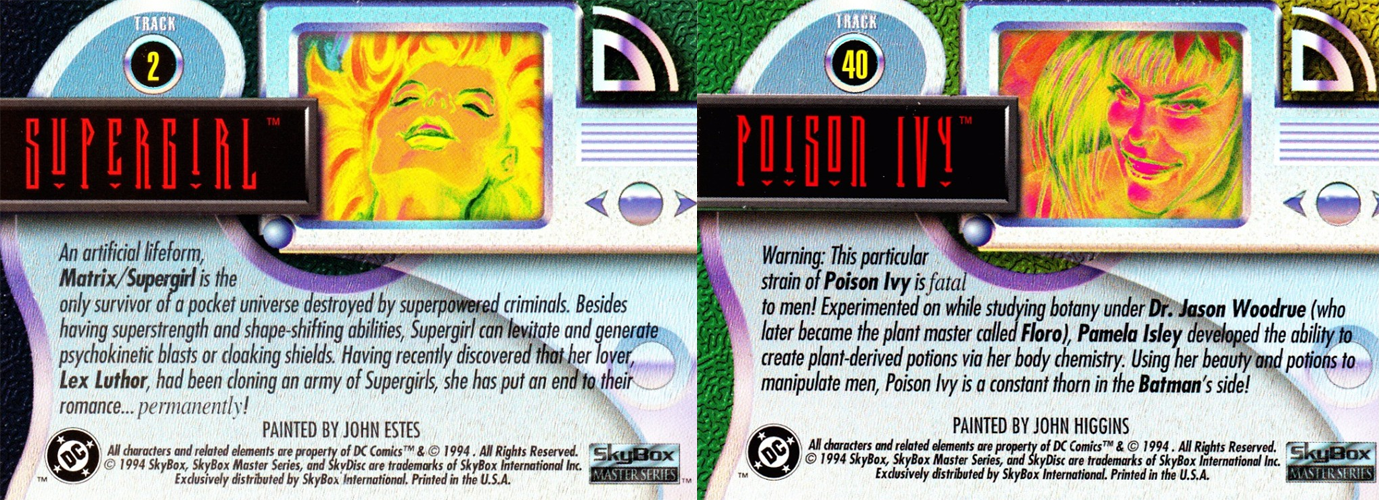
Card backs to the 1994 DC Master Series Supergirl and Poison Ivy cards. Notice the move toward less trivia.
The DC Master Series took after the Marvel Masterpieces and X-Men Ultra more than any other lines. The card collection was fully painted, with foil-stamped character names and, according to the box, “high-fidelity printing used on selected paintings to intensify the impact of the artwork.” Rather than cramming as much information as they could onto the card backs, biographies were kept to terse elevator pitches, to afford more room for graphic design elements. Batman and his friends and foes were finally in the line (while in the same year, SkyBox also capitalized on having the Bat-License by producing a similar, solely Gotham-focused Batman: Saga of the Dark Knight Series).

Batman, Two-Face, and Azrael-Batman, by Dave Dorman.
I bought a box of DC Master Series trading cards on eBay. It cost me $70, and this is only because the box had been squashed at some point and its little cardboard sides split. A pristine box will run you upwards of $100.
For $70, I received a squashed box (#196,564 of 200,000 individually numbered boxes) containing 36 packs of trading cards, with 6 cards per pack. The original MSRP of a pack in 1994 was $1.49. ($3.08 in 2023 dollars; good luck finding any non-sport trading card that will cost you three bucks a pack, especially now that superhero trading cards are mostly sold on the basis of how many chase card “hits” are in a given a box.) At $70, I was paying around $2.00 per pack.
Between these 36 packs that cost me around $2.00 each, I did not complete a 90-card base set. We’ll get to that.
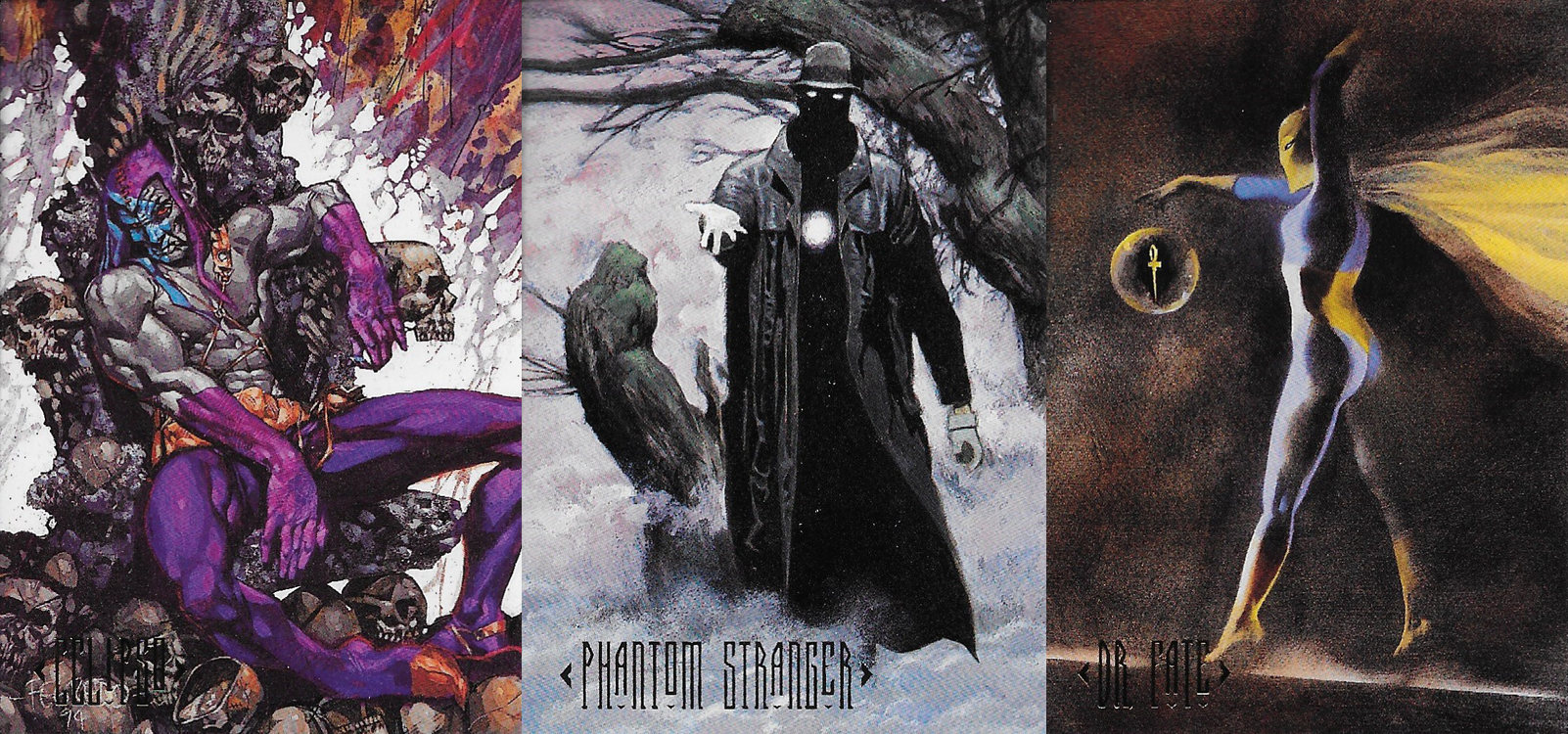
Eclipso, by Duncan Fegredo; The Phantom Stranger, by Scott Hampton; and Doctor Fate, by Jon J Muth. The Phantom Stranger card is a prime example of how the UV coating on the cards congealed a bit over the last three decades, and so packs of cards sometimes have to be ‘unpeeled’ from one another — sometimes with some of the color sticking to the other card. Especially annoying since it makes it look like I didn’t clean the dust off of my scanner bed. Also, in 1994, Doctor Fate was a woman.
First, let’s get back to the “fully painted” aspect of the cards. Many of them are very solid renditions of your favorite characters. Some of them even do the job of making embarrassing 1990s blips look cooler than they had any right to look. There seems to be an editorial mandate in play of not going too far off into the weeds — Kent Williams’s dissipated Deadman and Jon J Muth’s hazy Doctor Fate are really as “weird” as any portraits get. Most of the artwork is faithful, on-model renditions of characters standing around, or throwing their bodies into an action pose under unclear circumstances.

The Joker, Bane, and Catwoman, by Dave Dorman.
The cards don’t bear explicit sub-headers in the way that, say, Cosmic Cards had “Earth’s Mightiest Heroes” and “Earth’s Mightiest Villains,” and Cosmic Teams broke things up by characters’ group affiliations. Nonetheless, there’s still an organizational aspect at play. For example, the first nine cards are all Superman characters, painted by John Estes. The next nine are all Legion of Super-Heroes characters; the nine after that, a grab bag of space characters, Titans characters, and the leaders of the Justice League Task Force and Extreme Justice C-teams; then the nine after that, all Batman characters painted by Dave Dorman; et cetera.
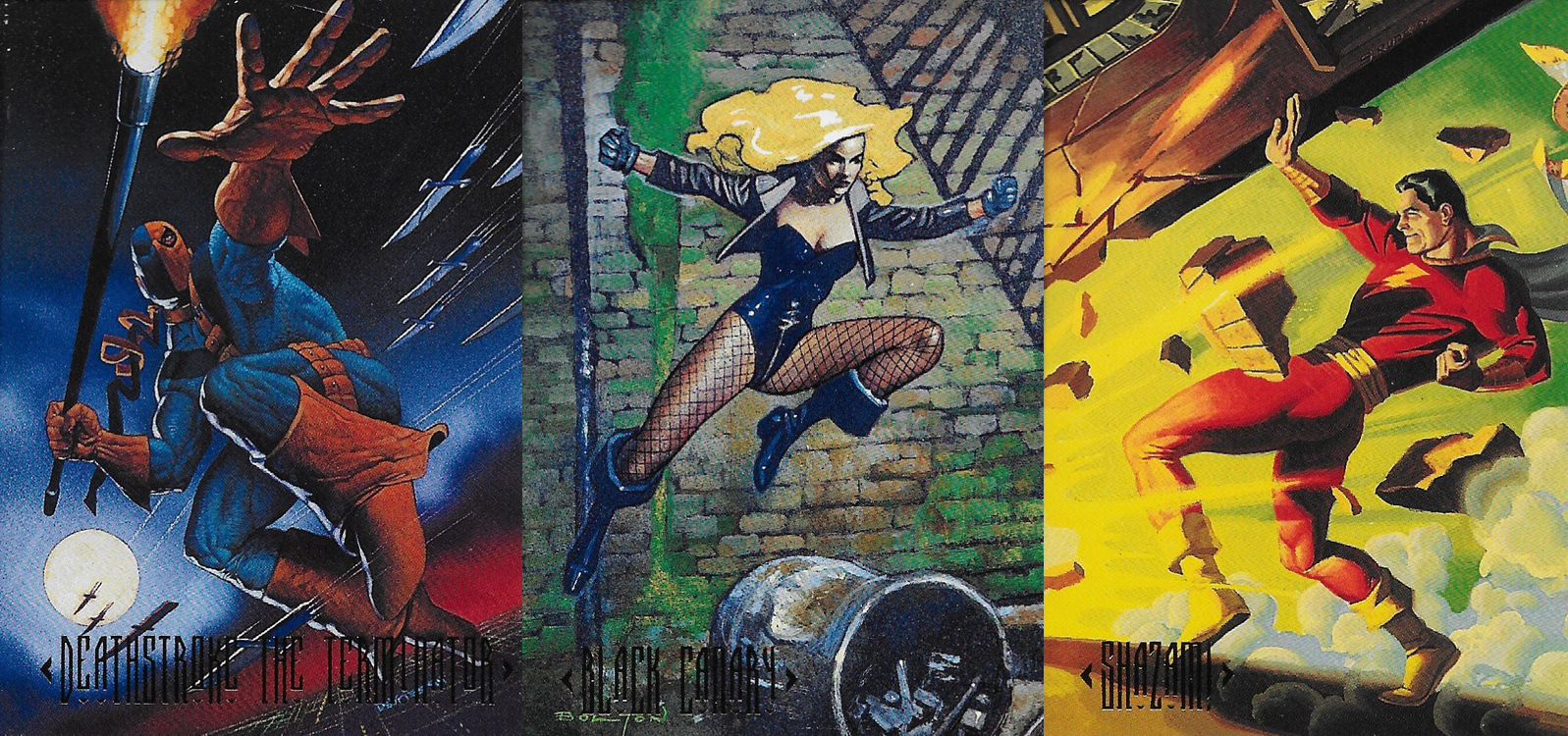
Deathstroke (the Terminator), by Dave DeVries; Black Canary, by John Bolton; and Captain (Shazam!) Marvel, by Steve Rude.
One of the fun things about this era of trading cards is seeing characters rendered by artists who would otherwise never come anywhere near them, whether by luck or judgment. The silver-skinned Captain Atom is painted by Julie Bell, one of the top painters of both chromed-out metal AND bodybuilder musculature. Duncan Fegredo paints a decadent yet intimidating Eclipso. Dave DeVries paints a nasty Lobo and a fearsome Deathstroke. Steve Rude puts extra Kirby into his Guardian painting. John Bolton takes on Hawkman, Hawkwoman, Black Canary, Wonder Woman, Power Girl… Bolton who, at that point in time, was more known to DC audiences as the artist of one issue of Neil Gaiman’s Books of Magic.

Argus, by Joe Phillips; The Flash, by Hector Gomez; and Anima, also by Joe Phillips.
There are also artists who lean into the big, bright, bold superhero aesthetic. Joe Phillips, one of the founding members of 90s all-stars Gaijin Studios, applies his smooth and appealing touch to a set of “young DC heroes of the 90s” that includes such lasting and wonderful ideas as Gunfire, Argus, and Faust. Hector Gomez, an Argentinian-born, Brazilian-based artist who would go on to draw Battlestar Galactica and Buffy the Vampire Slayer comics, handles the Flash family and an assortment of seemingly-random DC heroes (The Atom! Maxima! Huntress!) by really leaning into comic book action and energy. Gomez in particular has his characters DOING stuff in a way that stands in contrast with, say, (Watchmen and Batman: The Killing Joke colorist) John Higgins’ cards of villains, most of whom are depicted posing for trading card paintings.
Now then: back to how I’m missing a third of the base set.
Where the DC Master Series comes apart is in the allocation of the cards. “Allocation,” in this sense, refers to the distribution of the individual cards within the greater production run. If a trading card series had perfect individual allocation, then a box with 216 individual cards would contain around 2.4 complete base sets. Whatever formula that SkyBox used must have been a cheap and easy one, because it hopefully wasn’t intended as an MKULTRA experiment in deja vu.

Some of the new character looks for 1994: Booster Gold, Booster Gold’s massive armor, and Blue Beetle, by Cathleen A. Thole; Raven and her evil bikini, by John Higgins; and the rookie Green Lantern, Kyle Rayner, by Tony Harris.
Out of 36 packs, 3 of them contained these same cards, in this precise order: Superman, Changeling, Poison Ivy, Orion, Triumph, Batman. Another 3 packs went Virus & Pulse, Hawkwoman, Arsenal, Supergirl, Gypsy, Black Adam. Another 3 went Dr. Fate, Raven, Green Lantern, Aquaman, Eradicator, Mirage. Another 3 went The Demon, Catwoman, Hal Jordan, Shazam!, Glorith & Mordru, Nightwing.
A 36-pack box contains 216 cards. Let’s assume that the 1:18 odds of foil chase cards are on the money and you get two of those in a box. (Which I did.) That’s 214 cards. Of those 214 cards, 72 are taken up by the preceding paragraph. If you opened a pack and saw either Superman or Batman at one end, you knew every card that was in between them. It also meant that, between those above 72 cards, and numerous other packs that were “doubled” within the box, for $70 I got a lot of doubles and triples, and didn’t finish the 90-card set. The moments of greatest excitement came when all six of the cards didn’t require being gently broken apart (thanks to 30-year-old UV coating). This meant that one of the cards was a foil chase card, because the others weren’t sticking to it.
I wish I could say that the artwork on the cards was uniformly thrilling enough to deserve the purchase of multiple factory boxes just to get a complete set. But it’s not. If you really have to have the 1994 DC Master Series, just buy a loose set off someone. It’ll spare you a headache, if no other upside.


The sports card market during the pandemic was fascinating. Suddenly, everyone was an “investor” and was making Youtube videos of how to make a fortune selling cards. (Hint, in the rare times when the market is exploding, it’s EASY to make money selling shit no one’s ever wanted.) Now, panic is setting in as the cards are plummeting in value and guys are realizing that paying $5K for a current player can backfire when it turns out the guy knocks up minors in the Dominican Republic.
The one side effect is that a lot of the ’80’s and ’90’s junk wax is finally getting consumed. Most of it got bought up by people who then opened it up on Youtube. It was cheap content that got views. So, the hundreds of thousands of unopened 1988 Donruss baseball boxes is now a lot lower.
Action figures got caught up in this, too. Really, every collectible did. Now that the market is flattening out, we’ll see how much of this stuff is really liked vs. people buying cheap nostalgia.
It’s cool to see the post-bubble ’90’s stuff, though. It took the card/comic companies a while to get the memo that the market had evaporated. But, if their stuff was selling, they were going to produce. But, you really don’t see stuff from ’95 to ’03 or so really opened up. It’s kind of a lost era. But, it’s still pretty worthless, at least in the sports card world.
LikeLiked by 1 person